

What-if analysis advantages are numerous. From an individual to teams and organizations, everyone can use it to their advantage. In my article, I’ll highlight how helpful it is, and refer to blogging examples.
I often find that my business degree has given me handy skills. For example, it even supports me when I work on my terms. I can use the frameworks that I learned, applying them in the context of blogging.
What-if analysis benefits
1. About the tool
A what-if analysis is also called sensitivity analysis (more on Wikipedia). It’s a powerful tool that can be used in many circumstances. Use it in forecasting, coming up with various scenarios, and finding potential outcomes. Based on the results, you can make better-informed decisions.
Sensitivity analysis is a mathematical model. It can be used at an advanced level, or for simpler reasons as well. Anyone without advanced technical skills can benefit when it comes to simple analysis.
I use it for my blog for certain types of decision-making. While Excel can be used, I prefer using Google Sheets. As a user of Google Workspace, I have a variety of handy apps that are included.
If you want to find out how spreadsheets can support you in daily life, read my other article. It shows you how you can benefit in your personal and professional life. I find spreadsheets so convenient and can access notes anytime on my phone.
2. Test blogging strategies
As my article focuses on blogging, I’ll refer to related examples. The points are valid for anyone. When applied to other circumstances, they’re as much relevant.
I’ll also highlight how easily you can use the technique. For simple scenarios, anyone can use spreadsheets. Comparing and selecting the best option is a crucial step.
3. Mitigate your risks
Explore different scenarios that are likely to occur. Get a bird’s eye view of possible consequences. Use it to your advantage.
Risk is something that you have to take. Whatever your level of tolerance to it, there will be times when you cannot avoid such challenges. Make a table and play around with values in it to view different results. Take action to mitigate your risks (find out more in my older article).
4. Qualitative insights
Take a look at different scenarios. Evaluate their consequences. See how each could have an impact.
The tool focuses on numbers. Use it for statistical reasons. At the same time, consider the qualitative side as well.
The qualitative side of things means a lot. Take a balanced view. Consider all angles for better results.
A complete approach is best. You can use complementary tools. For example, Set SMART goals, and conduct a SWOT analysis. SMART stands for specific, measurable, assignable, realistic, and time-related. SWOT is the acronym for strengths, weaknesses, opportunities, and threats.
5. Financial Planning
Sticking to your blogging budget could be one of your goals. Especially at the start, funds may be limited. You could choose to forecast your yearly expenses with the use of a table.
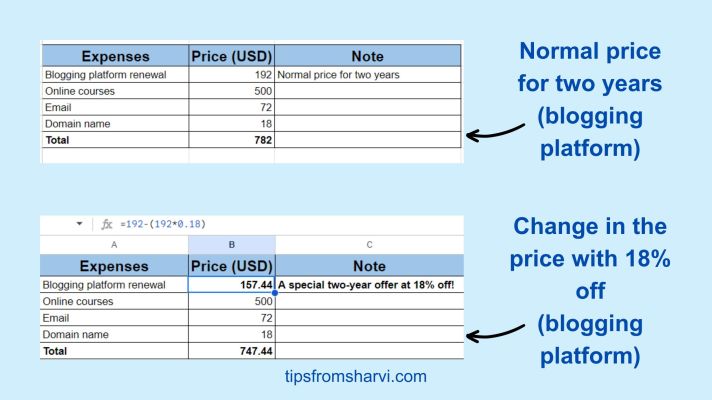
You might save money by making the right decision. For example, you could get a special offer for a two-year plan. The deal offers you an eighteen percent discount when paid at once. You may prefer to thoughtfully consider the feasibility before taking action.
In my illustration below, I highlight the effect of a discount on my total expenses. Simply by changing the formula in a cell, I see the overall effect. I could also change different cells to test how they impact the total amount.
6. Potential Outcomes
Find various results of different variables. If x changes, what happens? What if Y changes? Different changes bring different outcomes.
It’s a crucial method of examining possibilities. You can thus, proactively plan and do your best to avoid undesired outcomes. You can also spot what you should focus on, for better success.
7. Better predictability
When you observe different possible scenarios, you can compare them. It’s easier to evaluate the potential outcomes. Based on the results, you can make predictions more confidently.
Foreseeing what can occur is a valuable thing. Take measures to minimize the chances of unwanted events. At the same time, optimize those that you desire most.
8. Timely project completion
Examine what could cause a delay in your work. For example, you could plan to publish ten new articles next month. Break down the tasks involved, and allocate an average time spent on each. Find out if ten articles is a reasonable number.
You could find that you’re short on time. Ask yourself if it’s realistic to publish that much content in thirty days. You might want to prioritize quality over quantity.
You could adjust your plan. Either keep your goal for the ten articles and work smart, automating what you can. Alternatively, say no to burnout, and review your goal to fewer articles instead.
9. Breaking even
Profitability is a crucial part of any business. If you monetize your platforms, you’ll agree. Before making profits, you need to cover your expenses. When expenses are equal to profits, you break even.
Your aim might not be to just break even. However, you need to cover your costs in the short term to survive. Blogging, fortunately, isn’t very risky financially. However, you need to cover the cost of running your activity.
Change values in different cells. See how each would affect your revenue. Consider an unexpected increase in web hosting or increases in several tools. Plan how you would ensure the continuation of your activity.
10. Effective team consensus
If you work with a team, use the framework as well. If you’re already an advanced blogger, you could be working with freelancers. Use the tool to forecast teamwork.
One example could be project deadlines, based on allocated tasks. You could also benefit from financial forecasting. There are many different ways, just pin down your needs.
You might be networking with other content creators. If you work together on summits or other events, use the technique. Forecast, predict, and find possible scenarios, and their outcomes.
When looking at a variety of scenarios, take a step back and pause. Be mindful, and consider each one thoughtfully. Use the insights to your advantage for better decisions.
Conclusion
Being a blogger, you have a lot to do. Working solo or in a team, carefully consider different perspectives. Seize opportunities by conducting a what-if analysis, for the advantages it brings.

 Tips from Sharvi
Thanks for sharing, Sharvina. It’s really interesting. Hugs.
LikeLiked by 2 people
My pleasure, Teagan. Have a terrific day!
LikeLike
This is a most helpful post. I am saving it for regular reference. Your knowledge and expertise in your field are definitely reflected in this post.
Thanks for sharing this post, Sharvina.
LikeLiked by 1 person
My pleasure, Ranjana. Have a splendid day!
LikeLike